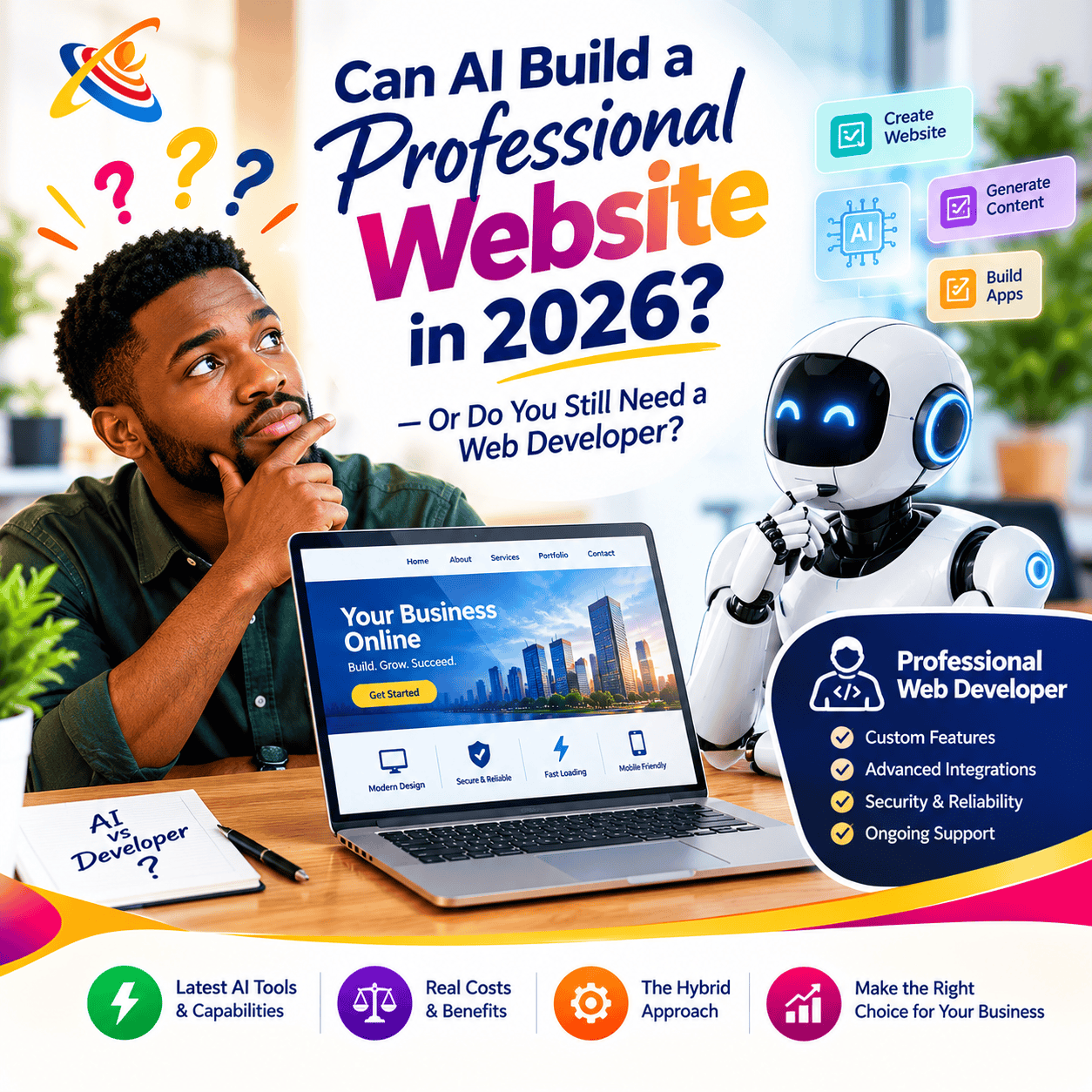
Can AI Build a Professional Business Website —or Do You Still Need a Web Developer in 2026?
Go ahead and type “build me a website for a bakery” into any major AI design tool today. In less than sixty seconds, you will watch a fully formed webpage materialize on your screen. It will have pristine stock images of croissants, neatly formatted pricing tables, a contact form, and surprisingly coherent marketing copy.
If you are a business owner looking at that screen, a very logical question comes to mind: Why on earth would I pay thousands of dollars to a professional web developer when an AI can do this for free before my coffee gets cold?
It is a valid question. By 2026, generative AI hasn’t just improved; it has entirely disrupted the entry-level web design space. Simple, static websites have essentially become a commodity.
But there is a massive gulf between a website that looks nice on the surface and a digital asset that securely scales, processes complex workflows, ranks on search engines, and drives actual revenue for an enterprise.
Let’s take an honest, unhyped look at the reality of web development in 2026. Can AI truly handle a professional business website on its own, or are human web developers still the secret weapon behind successful digital platforms?
Where AI Website Builders Completely Excel
To understand where AI falls short, we first have to acknowledge what it does exceptionally well. The capabilities of AI builders in 2026 are genuinely impressive, and they have completely redefined the baseline for getting online.
- Instant Prototyping: If you need to visualize an idea or pitch a proof-of-concept to investors, AI can spin up a functional mockup in seconds.
- Overcoming the “Blank Page” Syndrome: AI is a phenomenal assistant for wireframing layouts, generating initial color palettes, and drafting foundational copy that you can later refine.
- Solopreneur Landing Pages: For a local consultant, a wedding photographer, or a brand-new side hustle that simply needs a digital business card, a template-driven AI builder is often more than enough to get started.
Essentially, AI has lowered the floor of web design. It has made it easier than ever for anyone to occupy a tiny corner of the internet. However, it has not lowered the ceiling of high-level web engineering.
The Hidden Cracks: Where AI Platforms Fall Short
When you attempt to transition from a basic landing page to a robust, revenue-generating business platform, fully automated builders rapidly hit a technical ceiling. If you are building a website to support a growing company, these four major limitations are critical to keep in mind.
- The Walled Garden and Messy Code
When you use an AI website builder, you rarely own the underlying architecture. Your site is effectively trapped inside a proprietary ecosystem. If your business expands and you decide to export clean source code or migrate to a more powerful dedicated hosting provider, you will find yourself completely locked out.
Furthermore, the code AI generates behind the scenes is notoriously bloated. Because the algorithm pulls from disparate, generic code libraries just to make elements look visually appealing on the front end, it creates heavy files. The result? A sluggish website that takes too long to load on a mobile phone—instantly hurting your user experience.
- The “AI Aesthetic” and Brand Dilution
Let’s be honest: by 2026, internet users have developed a keen eye for spotting generic AI websites from a mile away. They all utilize the same predictable layout grids, identical font pairings, and formulaic hero sections.
If your website looks indistinguishable from three of your competitors because you all fed similar prompts into the same software, you have a severe branding problem. AI can mimic current design trends, but it completely misses the human nuance, the brand identity, and the authentic story that makes your business unique.
- Panic at Complex Business Logic
A simple brochure website is easy for a machine to build. But what happens when your business requires deeper operational capabilities?
Imagine you need a secure, encrypted portal for premium clients, a complex multi-vendor marketplace, or a custom checkout funnel that synchronizes with your physical warehouse inventory in real-time. This level of infrastructure requires tying together custom databases, internal CRMs, and payment gateways. When you prompt an AI to engineer that specific tier of architecture, it inevitably breaks down.
- Surface-Level SEO Disconnect
Sure, an AI can effortlessly write meta descriptions and title tags. But true organic visibility is not a static checklist; it is an ongoing game of strategy.
AI platforms heavily struggle with the foundational backend architecture of SEO. They fail at constructing custom schema markups for localized search optimization, and they cannot map out a logical internal linking web that signals to Google which of your pages possess the highest commercial authority. Most importantly, AI cannot look at live competitor strategies and deduce the exact content gaps you need to exploit to outrank them.
The Irreplaceable Value of a Web Developer in 2026
So, why are businesses still hiring human developers in 2026? It isn’t because developers are faster at typing code than an AI. It is because the role of a modern web professional has evolved from a simple “coder” into a strategic technology partner.
When you hire an experienced developer or a specialized digital solutions team, you are investing in crucial capabilities that machines simply cannot replicate.
Strategic Technical Architecture
A professional developer doesn’t just start building blocks; they ask about your long-term business goals. They design an architecture that is built to scale from day one. They ensure that if your traffic spikes by 1,000% during a product launch, your server will not crash. They meticulously select the right tech stack (whether it’s Next.js, React, or custom WordPress engineering) tailored precisely to your company’s five-year roadmap.
Ironclad Security and Compliance
In an era of rising cybersecurity threats, data integrity is paramount. If your website collects user data, processes credit cards, or stores medical or financial information, security cannot be left to an automated script. Human engineers implement custom firewalls, strict role-based access controls, and secure API integrations. They ensure your site remains compliant with global regulations like GDPR or local data protection acts, shielding your business from catastrophic legal and financial liabilities.
Conversion Rate Optimization (CRO) UX Design
A beautiful website is useless if it doesn’t convert visitors into paying customers. Human developers and UX designers study psychology. They understand how a user’s eyes move across a screen, where micro-interactions can reduce checkout friction, and how to structure a navigation menu based on actual human behavior. AI layouts are built on averages; human designs are built for specific, targeted results.
The Reality of 2026: The Hybrid Approach
The truth is, the debate shouldn’t be framed as Human vs. AI. The most successful web developers in 2026 are not fighting against artificial intelligence—they are leveraging it.
The relationship between developers and AI is very similar to that of an architect and a power tool. An advanced electric saw allows a carpenter to cut wood ten times faster, but the saw cannot design a structurally sound skyscraper.
At Jemsa Global Solutions, we look at the tech landscape through this hybrid lens. Our engineers utilize advanced AI tools to handle repetitive tasks like boilerplate code generation, basic testing scripts, and initial asset formatting. By automating the mundane, manual aspects of development, our team frees up their cognitive energy to focus entirely on what truly matters for your business:
- Devising custom software integrations that streamline your operations.
- Architecting data pipelines that give you clear business insights.
- Perfecting high-performance user experiences that outperform your competition.
We use AI to drastically accelerate the development timeline, passing that efficiency on to our clients, while providing the human oversight and deep engineering expertise required to build a flawless digital product.
The Decision Matrix: Which Path is Right for You?
If you are currently deciding how to approach your company’s next web project, use this straightforward breakdown to guide your choice:
Choose an AI Builder If… | Partner with a Web Developer If… |
You are launching a brand-new startup with a minimal budget. | You are an established business protecting an existing brand reputation. |
You only need a static brochure site or a landing page. | Your site requires custom workflows, user portals, or deep CRM integrations. |
You don’t mind utilizing generic templates that resemble other sites. | You require a unique, high-end digital experience that stands out. |
Search engine traffic is not a primary driver of your business. | Strategic organic SEO visibility is vital to your customer acquisition. |
The Verdict: AI Lowers the Barrier, Humans Secure the Future
AI has undoubtedly democratized the web. It has made the act of building a basic webpage completely accessible to anyone with an internet connection.
But a professional business website is not just a digital flyer; it is the virtual storefront, the operational hub, and the engine of your company’s growth. When your website directly impacts your bottom line, relying entirely on a generic prompt generator is an incredibly high business risk.
AI can build a website. But it takes a human developer to build a digital ecosystem that converts, scales, and survives.
Conclusion: Do You Still Need a Web Developer in 2026?
AI can build increasingly capable websites, and for some straightforward projects it can significantly reduce the time and effort required. It can also help experienced developers work more efficiently on complex projects.
But a website is not successful merely because it exists, looks attractive or was generated quickly.
It must meet the needs of its users, communicate the business clearly, function correctly, protect information and remain manageable after launch.
If your needs are simple, an AI website builder may be enough. If your requirements involve custom business logic, integrations, sensitive data or specialised workflows, professional development and thorough testing become more important. For many organisations, combining AI with experienced human oversight is a practical way forward.
The best decision is not to choose AI simply because it is new, or to choose a developer simply because that is how websites have traditionally been built. Choose the approach that gives your business the best balance of cost, capability, reliability and support.
Ready to Build or Improve Your Business Website?
Jemsa Global Solutions can help you assess your requirements and choose a practical website solution.
Website: https://jemsaglobal.com/
Call or WhatsApp: +234 808 094 2600
WhatsApp: https://wa.me/2348080942600
Follow Jemsa Global Solutions for practical website, business technology and ICT tips:
Facebook: https://web.facebook.com/Jemsaglobal/
Instagram: https://www.instagram.com/jemsaglobal/
Telegram: https://t.me/jemsaglobal
Jemsa Global Solutions — Your Reliable ICT Solutions Partner.