
"Success in business is not about working harder, but about working smarter and creating value that outlasts you."
A potential client hears about you and your business from a friend. They are interested in your products and the prices look reasonable and they want to patronize you. Then they search for you or your business on the internet.
They find nothing new but an old Facebook page, five pictures from 2020, a phone number that may or may not be working, and a post announcing a promotion that ended three years ago.
They are suddenly disappointed.
They ask themselves: Is this company still operating? Is it legitimate? Can I trust them? Is my money safe with them? Can They deliver?
On the other hand, your competitor has a professional website displaying products, contact information, testimonials and ways to contact them.
Guess who the potential client will go for?
Your competitor might not even offer a better product. They simply have made it easier for clients to reach them, understand them and trust them.
Welcome to business in this digital age, where customer does not visit your office before deciding whether they will do business with you or not.
The good news? You do not need to be a multinational company to establish a professional online presence. A well-designed website will help a small business communicate professionally, showcase its products and services, answer customer questions and create business opportunities.
At Jemsa Global Solutions, we believe that every serious business should know how it presents itself online.
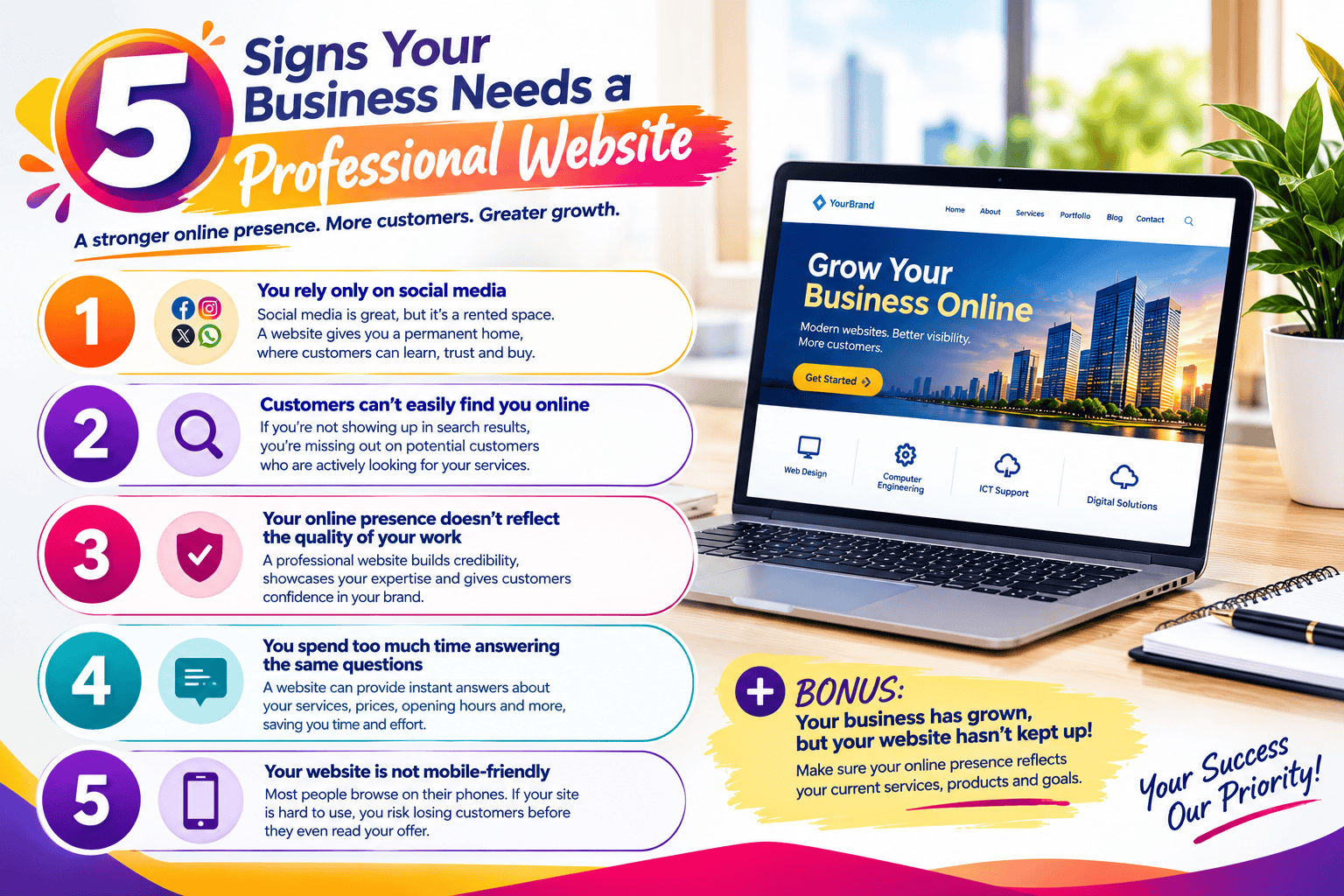
Here are five important signs to look out for, plus a bonus sign that many business owners overlook.
1. Your Business is Entirely on Social Media
Social media is fantastic for business. Facebook helps you connect with various customers, Instagram showcases your products clearly, and WhatsApp makes conversations convenient and fast.
There is one small problem with making social media your business headquarters: you are building and running your entire office on rented real estate.
You can spend years building a loyal fanbase, only to find out one day that your account has been restricted, your reach has declined, the platform has changed its rules and your customers cannot find an old post containing vital information.
And here is another point: when someone asks, “Please send me your website address,” what exactly do you send to them? Your Instagram handle for the eighth time, that is embarrassing?
That is not completely wrong, but you are missing a great opportunity to provide a more organized personalized business experience.
A professional website gives your company a central internet destination where customers can learn about your company, browse your services, read frequently asked questions, submit enquiries and find your official contact information and all this information are yours and yours alone and can’t be brought down or locked by anyone at any time except you.
You can use social media to attract attention but your website is the place where interested people and possible investors can learn more and build a stronger relationship with you.
Fact Based on Research:
One Verisign survey published in 2015 reported that 86% of surveyed consumers preferred businesses to have a website rather than just a social media page, while 77% of surveyed consumers believed a website made a business appear more credible and trustworthy.
Here is a Relatable story: Ada, who sells beautiful clothes through Instagram. Her photographs are excellent, customers leave positive comments, and her followers are increasing. Business is doing great.
A potential corporate client wants to order uniforms for more than 80 employees, and the customer asks for a catalogue, available sizes, delivery information, company details and a formal quotation.
Ada begins scrolling through hundreds of Instagram posts, and I know you can relate with that, searching for the right photographs. She sends screenshots, types long explanations and answers same questions repeatedly.
The corporate customer eventually chooses another Fashion Designer whose website provides a clear product catalogue, company information and a straightforward process.
Ada did not lose the order because her clothes were inferior. She made it harder for the customer to buy.
A professional website could have helped her organize her products, display business information and receive enquiries more efficiently.
The message: Good social media attracts attention, but a professional website helps you organize the customer experience and keeps them coming back for more.
If your business currently operates only through social media, consider building a website that includes:
- A professional homepage explaining what you do.
- An About Us page introducing your business.
- Dedicated product or service pages.
- Clear telephone, email and WhatsApp contact options.
- A contact form for enquiries and quotations.
- Testimonials or genuine customer reviews.
You do not need hundreds of pages to start. You need the right information, presented clearly and professionally and consistently.
2. Potential Customers Struggle to Find Your Business Online
Imagine opening a beautiful shop in Lagos, stocking it with excellent products and waiting for customers to arrive. There is just one problem: nobody knows where the shop is. This is similar to running a business with little or no searchable online presence.
Today, customers search the internet before deciding which business to contact. They may search for a product, compare service providers, check opening hours or look for a company’s official contact details.
If your business or company has no website, you will be missing the opportunity to appear in relevant search results. A professional website gives search engines pages they can discover, understand and potentially display when users search for relevant products and services from anywhere in the world.
For example, a business selling office computers could benefit from useful pages explaining its computer supply services, maintenance options, location and quotation process.
A website alone does not guarantee that you will appear at the top of Google. Search visibility depends on many factors, including relevant content, technical quality, competition, authority and the usefulness of your pages.
But without a well-structured online presence, you have fewer opportunities to be discovered through your own website.
Fact Based on Research:
BrightLocal’s 2026 consumer search research reports that 84% of surveyed consumers had searched online for a local business within the preceding three months. Its research also highlights the importance of mobile-friendly online information.
Here is a Relatable True story: Chinedu, a talented computer engineer who has been repairing laptops and desktops for more than ten years.
He understands hardware, diagnoses faults accurately and has many satisfied customers. Unfortunately, most of his new customers come through personal referrals. One day, a company needs a technician to maintain computers across its offices. The procurement officer searches online for computer maintenance providers.
Several businesses appear with professional websites showing their services, locations, contact information and relevant experience. Chinedu’s business does not appear among the results.
The company never learns that he exists, even though he has the experience to do an excellent job.
Chinedu assumes that customers are not spending money on computer maintenance. In reality, some potential customers are simply finding other businesses before his.
A professional website with relevant pages, useful information and appropriate local search optimization could give Chinedu another channel through which potential customers discover his business.
The message: You cannot win every customer who searches online, but you should give interested customers opportunities to find you.
What should you do?
Start by ensuring your website has:
- Clear pages describing your products and services.
- Page titles and headings that accurately describe what you offer.
- Useful information written for the questions customers actually ask.
- A mobile-friendly layout.
- Fast, reliable performance.
- Where applicable, accurate business contact details and location information.
You should also consider creating or updating your Google Business Profile if your business is eligible.
Remember: search engine optimization is not magic doesn’t yield results overnight. It is a process of making your business easier for search engines and people to understand.
3. Your Business Looks Less Professional Than the Quality of Your Work
This can be very painful. You may provide excellent services, employ skilled workers and treat customers professionally and yet your online presentation might suggest that your business is still operating from the era of handwritten receipts and a computer that takes ten minutes to start.
There is nothing wrong with a humble beginning. Every successful company starts like that, however, your online presentation should reflect the quality and seriousness of the business you are building today.
A professional website can communicate your experience, explain your services, showcase completed projects, introduce your team and display genuine testimonials.
It can also answer important questions before a customer contacts you:
- Who are you?
- What exactly do you do?
- How experienced are you?
- Where do you operate?
- How can you be reached?
- What evidence do you have that you can deliver?
A customer should not need to become a private investigator to establish whether your business is legitimate.
Fact Based on Research:
Research conducted by the Stanford Web Credibility Project involved more than 4,500 people and produced guidelines for improving website credibility.
Among its recommendations were professional visual design, clear contact information, evidence of a real organisations, useful content and regular attention to accuracy.
The message is straightforward: how a website is designed and how clearly, it communicates can influence how people assess its credibility and how they can trust the business.
What does this mean for your business?
Suppose you run a cleaning company, a fashion brand, a consulting firm, a school or an ICT company.
A professional website can help you present:
- Your company background and experience.
- The services you offer and the customers you serve.
- Examples of completed work.
- Genuine reviews and testimonials.
- Relevant qualifications, registrations or certifications.
- Your official business contacts and enquiry process.
Aa beautiful website cannot replace good service, honesty or reliable delivery. It should support the quality of your business, not pretend that quality exists when it doesn’t.
And if your website says you have 15 years of experience, be sure you actually do. Professionalism is not a competition to see who can tell the biggest story.
The message: Your online presence should help customers recognize the value that already exists in your business.
4. You Spend Too Much Time Answering the Same Questions
“How much does it cost?”
“Where are you located?”
“What services do you offer?”
“Do you deliver?”
“What are your opening hours?”
“Can I see your previous work?”
If you answer these questions so often that your fingers could type the responses while you sleep, your business surely needs a better online information system.
WhatsApp and social media are excellent communication tools, but repeatedly explaining the same basic information can consume time you could use to serve customers, develop your business or complete paid work.
A well-designed website can answer many common questions before a customer contacts you.
For example, a website can display service descriptions, product information, frequently asked questions, opening hours, delivery policies and a contact form.
For businesses that sell products, an online catalogue can help customers understand available options. Depending on the business, a website can also support bookings, quotation requests or online orders.
This does not mean you should eliminate personal communication as some customers may still need advice, reassurance or a tailored quotation.
The goal is to spend less time repeating basic information and more time helping customers make informed decisions.
Fact Based on Research:
BrightLocal’s 2025 Consumer Search Behavior research reported that 85% of surveyed consumers considered the availability of contact information and opening hours important when researching local businesses.
That finding supports a practical point: customers value clear, accessible information when deciding which business to contact.
What does this mean for your business?
Create a website that makes essential information easy to locate.
Depending on your business, include:
- A clear description of your services.
- Prices or pricing guidance where appropriate.
- Frequently asked questions.
- Opening hours and service areas.
- A contact form and direct contact options.
- Product catalogues, booking options or quotation requests where relevant.
You can also use your website alongside WhatsApp Business, allowing customers to move from browsing to a conversation when they need personal assistance.
The message: Your website should answer routine questions so you can devote more attention to valuable customer conversations.
5 Your Website, If You Have One, Is Difficult to Use on a Mobile Phone
Perhaps you already have a website. Congratulations! But let us ask an important question.
Have you actually opened it on your own mobile phone recently? Not on your office computer but On your phone.
Can you read the text without zooming in? And Do the buttons work? Can you find the phone number? Does the contact form work? Can customers browse your products without the page jumping around like it has had too much coffee?
A website should be designed around the various devices and situations in which people use it.
A potential customer may be browsing while commuting, sitting in a waiting room or comparing dealers during a short break. If your website is frustrating to use on a mobile device, you will lose their attention before they even understand what you can offer.
Mobile-friendly design includes readable text, sensible spacing, easy navigation, properly sized buttons and content that adjusts to different screen sizes.
Speed matters, too. Large images, unnecessary scripts, poorly configured hosting and other technical issues can make a website feel slow or damaged.
Facts based on research:
BrightLocal’s 2026 research on consumer search channels reports that most local business searches take place on mobile devices. It also found that three-quarters of consumers used multiple channels during their most recent local business search.
This matters because customers may discover you on social media, search for your business on Google and then visit your website on their phones before deciding whether to contact you.
Your website should support that journey rather than interrupt it, and if you investigate it yourself you will see that you also follow that pattern when you are looking for a service or product to purchase online.
How can you check your website?
Try this simple five-minute test:
- Open your website on your mobile phone.
- Visit the homepage and at least two important service pages.
- Check whether the text is readable without excessive zooming.
- Click every important button, including WhatsApp, phone and enquiry links.
- Submit a test enquiry and confirm that it reaches the right destination.
- Check the site using Google’s PageSpeed Insights tool to identify potential performance and usability improvements.
The message: If your website is difficult to use on a phone, you may be making it harder for customers to use your business.
BONUS POINT: Your Business Has Grown, but Your Website Has Not reflected it
This is the sign that many established businesses overlook.
Perhaps you started with one service and now offer six. Maybe you began selling to individuals but now serve corporate organisations. You may have added new branches, introduced new products or developed an entirely new business model entirely.
Yet your website still describes the company you were four years ago.
Your homepage announces a promotion that ended years ago. Your services page does not mention your latest services. Your contact form sends enquiries to an email address you have forgotten the password to.
Congratulations: your business has moved forward, but your website is still back in time.
An outdated website can create confusion, seriously harm your credibility, hide your current capabilities and make new potential customers question whether the information they see is accurate.
Why does this matter?
Stanford’s web credibility guidelines recommend keeping website information accurate and showing that content has been reviewed recently. The research also identifies errors, broken links and unclear information as factors that can undermine credibility.
The point is not that you must redesign your entire website every month. It is that your website should reflect the current state of your business.
What should you review?
At least periodically, monthly or quarterly, check if:
- your services and product information are current.
- your prices and promotions are accurate.
- your contact information works.
- your website is secure and functioning properly.
- your testimonials, portfolio and company information remain relevant.
- the website still supports your current business goals.
A website is not a poster you print once and forget in a cupboard. It is a business asset that should evolve alongside your company.
The message: Keep your online presence aligned with the business you are today, not just the business you used to be.
So, Does Your Business Need a Professional Website?
Let’s recap the warning signs.
You should seriously consider investing in a professional website if:
- Your business depends entirely on social media.
- Potential customers struggle to find you online.
- Your online presentation does not reflect the quality of your work.
- You spend too much time answering the same basic questions.
- Your website is difficult to use on mobile devices.
- Bonus: Your business has grown, but your website has not kept up.
A website is not a magic button that guarantees sales. It does not replace excellent service, effective marketing, customer relationships or a good business model, really it isn’t.
What it can do is give your business a stronger digital foundation.
It can help you present your services professionally, provide useful information, support online discovery, simplify enquiries and create a central destination for the customers you attract through social media and other channels.
And you do not necessarily need an expensive, complicated website to begin. The right solution depends on your business, your customers, your goals and the features you actually need.
The important thing is to start with a clear purpose and build something that serves your customers.
Ready to Give Your Business a Professional Online Presence?
At Jemsa Global Solutions, we help businesses establish and improve their digital presence through website design, web development, computer hardware engineering and other ICT-related services.
With more than 21 years of business experience, we understand that technology should do more than look impressive. It should help solve real problems and support your business goals.
Our current website design packages start at ₦50,000, with additional options at ₦150,000 and ₦250,000, depending on your requirements.
Whether you need a basic business website, a more advanced corporate website or an e-commerce platform, we can discuss your needs and help you identify a suitable solution.
Let’s build your digital presence.
Jemsa Global Solutions
🌐 Website: https://jemsaglobal.com/
📞 Call: +234 808 094 2600
💬 WhatsApp: https://wa.me/2348080942600
Follow us on social media:
- Facebook: https://web.facebook.com/Jemsaglobal/
- Instagram: https://www.instagram.com/jemsaglobal/
- X: https://x.com/jemsaglobal
- Telegram: https://t.me/jemsaglobal
Your business deserves to be seen, understood and trusted. Let’s build the online presence that helps make it possible.
Jemsa Global Solutions — Your Reliable ICT Solutions Partner.


